The Voigt Airfield bluff
The Running ManThe Voigt Airfield bluff is the climactic deception by which Ben Richards converts imminent capture into a temporary bargaining position. At Voigt Airfield, surrounded by police, an A-62 tank, a hostile crowd, and the institutional machinery of the Games Federation, he claims that a massive stock of military-grade explosive is hidden in his coat. The lie does not merely postpone arrest: it reverses the immediate value structure of the scene, changing Ben from hunted prey into a threat whose supposed power compels the state to negotiate. Its success is both tactical and tragic, because the bluff protects Amelia Williams while carrying Ben toward a confrontation from which no ordinary escape remains evident.
Causes and Setting
The bluff develops from a pursuit that has steadily narrowed Ben’s available spaces. His journey begins south of the Canal in Co-Op City, where deserted shops, stripped vehicles, rats, cycle gangs, unemployment, and the absence of effective policing make poverty physically visible. Crossing the Canal takes him into a more guarded and affluent district, where police watch anyone who appears poor and displaced and where the Network Games Building represents the single institutional purpose assigned to a man like him: participation in the Games. The geography is therefore not neutral. The Canal functions as a class boundary, and every subsequent movement toward official buildings increases surveillance while reducing personal freedom.
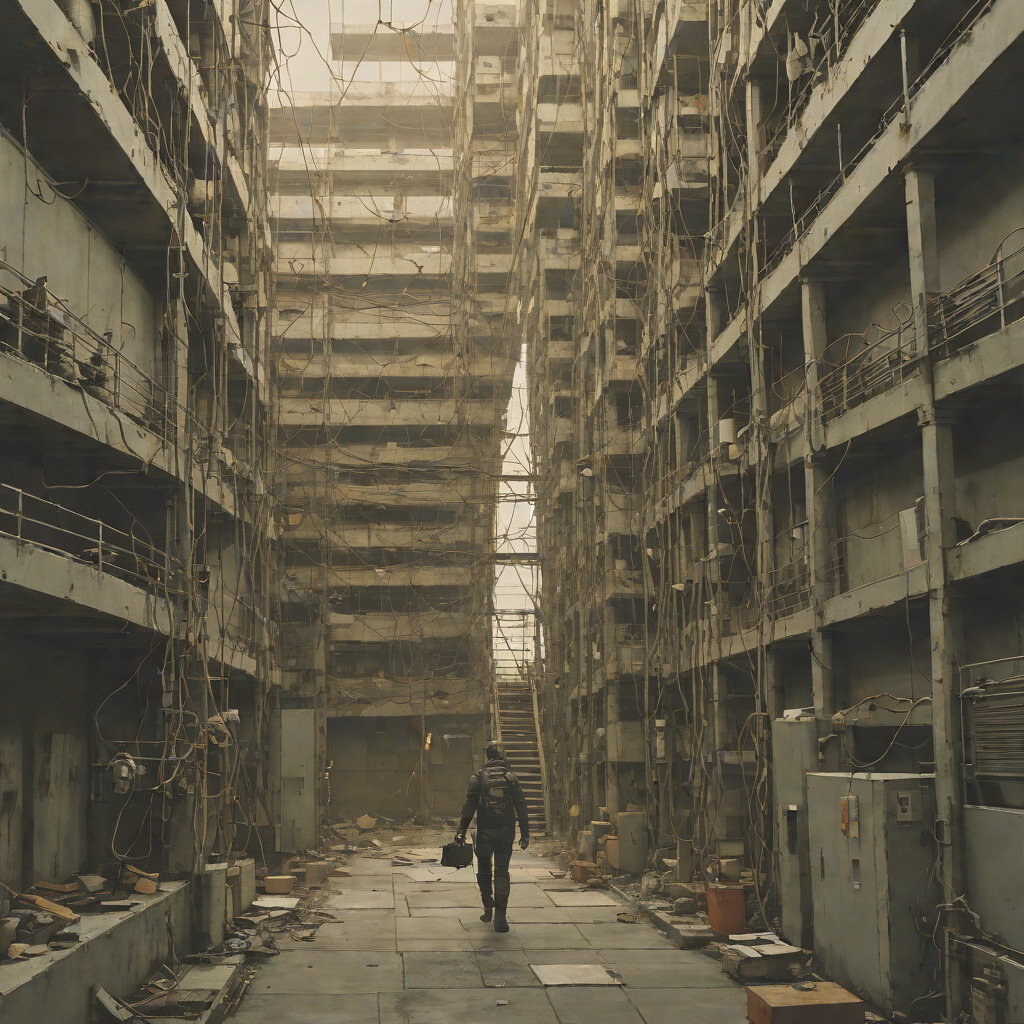
The Boston Y.M.C.A. has already become part of that pressure system. Its decaying, old-fashioned structure is described as the skeleton of a murdered idea, a remnant of an earlier civic world now surrounded by the machinery of spectacle and repression. Later, the unfinished Super Pine Tree Mall provides Ben and Elton Parrakis with a sprawling maze of foundations, rusted steel, abandoned huts, and overgrown construction. These spaces offer concealment but not security. Voigt Airfield is the opposite: a purpose-built infrastructure of roads, gates, terminals, police vehicles, tanks, fences, cameras, and crowds. It is open enough to expose a fugitive and controlled enough to make escape almost impossible.
The airport also concentrates the story’s media logic. Employees and passengers are held back by police while cameras record the encounter, and the audience’s presence is multiplied by the millions watching the broadcast. The Games have repeatedly edited Ben into a public monster: his face is airbrushed into an urban bogeyman, his wife Sheila Richards is falsified into a figure of greed, and Bobby Thompson presents him as a wolf who walks among ordinary people. At the airfield, that manufactured image becomes a practical weapon against him, but it also gives him a weapon of his own. If the authorities need the spectacle to be credible, then a televised threat can force them to behave as though it is real.
What Happens at Voigt Airfield
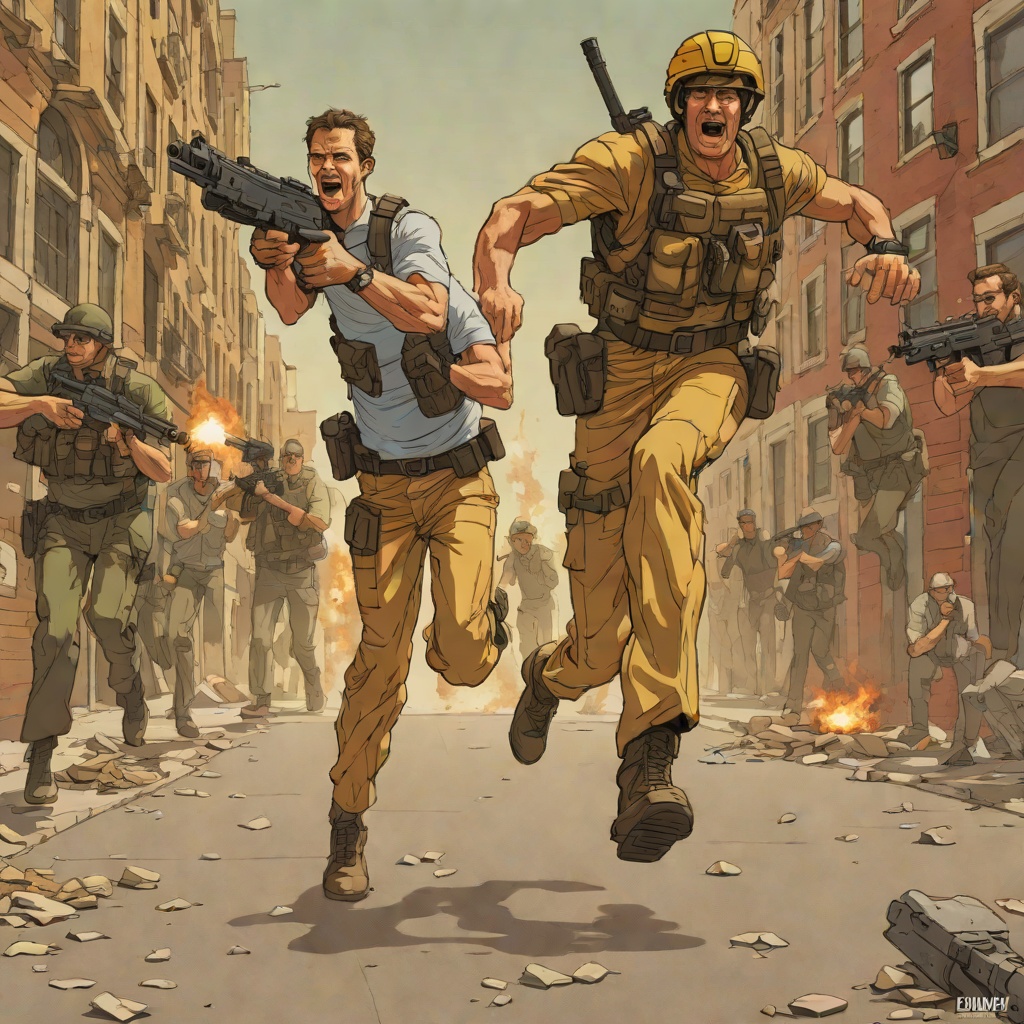
The immediate approach is conducted under military threat. Amelia Williams is driving while Ben directs her toward the airport. A tank blocks the main gate, its cannon capable of firing quarter-megaton shells, and the access road is lined with police cars and a crowd whose noise becomes a continuous scream and babble. The gate is eventually opened, but the authorities order the car to proceed to Lot 16, where Airline Police will take Ben into custody. Ben tells Amelia to drive farther inside and then stop, making clear that the airport’s apparent permission to enter is still only a controlled movement toward arrest.
At Lot 16, Ben uses a bullhorn to announce that he is carrying twelve pounds of Dynacore high-impact plastic explosive, the variety called Black Irish. He claims that the quantity is enough to destroy everything and everyone within a third of a mile and may also detonate the jetport fuel-storage tanks. He adds a specific technical detail: a General Atomics Imploder ring is set into the explosive and has been pulled out to half-cock, so that one movement could trigger the blast. The precision of the claim is essential to the bluff. It supplies not only menace but an apparent mechanism, scale, and immediate danger.
The announcement produces the reaction Ben needs. The crowd breaks through the police lines and flees across roads and fields, streaming out of the gates and climbing the cyclone fence. The police do not dismiss the claim as impossible; the absence of disbelief on their faces shows that the bluff has entered the official reality of the scene. Cameras continue to record, and the press appears uneasy, but the possibility that the explosive is only a fiction cannot safely be acted upon. The state’s power is suddenly constrained by the risk of being wrong in public.
Evan McCone then steps forward. He identifies himself as the Chief Hunter, a figure Ben already associates with the Network’s repressive authority and with the frightening lineage of official pursuit. McCone says that Ben is lying because a man without a Games Federation rating should have no way to obtain Dynacore, and he demands that Amelia be released before Ben surrenders. Ben counters that Dynacore can be bought in the streets if a person has cash, and he states that he paid with Games Federation money. He gives McCone eighty-six minutes, transforming the encounter from an arrest into a timed negotiation.
The bluff’s first concrete victory is Amelia’s release. Ben tells her to go, and she lunges through the door, half falling and half springing onto the airfield before running into the glare of a million flashbulbs. Carbines rise and then lower as the crowd absorbs her. Ben remains in the car, watches, and waits for what he imagines will be his dissolution. His threat has achieved its humane purpose, but it has also removed his only immediate hostage and left him alone at the center of the spectacle.
The Negotiation and Its Reversal
After Amelia escapes, Ben continues the performance by announcing the passage of time and insisting that McCone act under the terms of the threat. The authorities respond that they need at least three hours because no suitable aircraft is available on the field and one must be flown in. This request is a reversal of the expected power relation. The police still surround Ben, but they are now asking him to wait rather than ordering him to submit. His fictional explosive has forced the institutions that control the airport to acknowledge a limit to their own control.
The delay is also a form of public proof. The threat has been broadcast, witnessed, and answered; any decision to shoot becomes a decision made under the eyes of the watching population and the cameras. The spectacle that previously condemned Ben now restrains the authorities. This is why the bluff is more than a private deception. It is an intervention into the Network’s preferred frame of reality, in which Ben is only a killer, the police are protectors, and the audience is a passive judge. By making the audience’s fear part of the tactical situation, Ben briefly turns propaganda’s circulation against its makers.
Yet the achievement remains unstable. McCone’s challenge rests on the possibility that the threat is technically impossible, while Ben’s response depends on the existence of an underground market and on the money he acquired through the Games Federation. Neither side can establish the truth without risking catastrophe. The scene therefore runs on a charged uncertainty: the authorities cannot believe Ben, but they cannot safely disbelieve him either. The bluff succeeds precisely because disbelief has become too dangerous.
Consequences and Significance
The Voigt Airfield bluff gives Amelia a chance to survive and grants Ben additional time, but it does not restore his freedom. It merely changes the terms under which he is trapped. Earlier, the Network uses manipulated images and edited recordings to make Ben appear primitive, murderous, and eager to mobilize violence. At Voigt Airfield, he answers that constructed criminal identity with a constructed capability. The result is an ironic contest between two forms of fabrication: the Network invents a villain to justify pursuit, while Ben invents a bomb to prevent immediate execution.
The event also intensifies the contrast between Ben’s private motives and the public story imposed upon him. The broadcast has falsely claimed that the Network had nothing to do with the deaths of Sheila Richards and Catherine Sarah Richards, describing them as victims of an accident or of unrelated prowlers. Ben’s memory of his family interrupts Dan Killian’s explanation with images of marriage, pregnancy, parenthood, and domestic tenderness, and Ben rejects the official account rather than accepting the proposed job. Against that background, the airfield threat is not presented as a detached criminal maneuver. It is the desperate public expression of a man whose family has been converted into broadcast material and whose grief has been denied by the same system now hunting him.
Spatially, the bluff completes a movement from marginal streets to the center of organized power. Co-Op City’s poverty is ignored south of the Canal; the Boston Y.M.C.A. is transformed into a site of official violence; the abandoned mall offers only temporary concealment; and Voigt Airfield displays the state’s resources in their fullest form. Tanks, Airline Police, fences, terminals, aircraft, and cameras make the airport nearly escape-proof, but the infrastructure also creates dependencies. The authorities require time, transport, coordination, and public credibility. Ben finds his narrow leverage inside those requirements.
The bluff’s final irony is that it wins by making Ben legible in the language the Games understand: scale, danger, ratings, weapons, deadlines, and spectacle. His ordinary claims about pollution, poverty, and institutional violence are falsified or edited into evidence of madness, while an invented bomb receives immediate respect. The scene thus exposes a society in which truth has less force than a credible broadcast threat. Ben’s temporary triumph is real, but it is a victory inside the Network’s arena, achieved with the same theatrical machinery that has been used to condemn him.